TypeSafe Jev Review: Benchmarks, Limits, When to Use It
Jev, TypeSafe AI's decision model, answers in ~100ms at $0.042/M tokens. What independent benchmarks show, how prompt injection sways it, and where it fits.
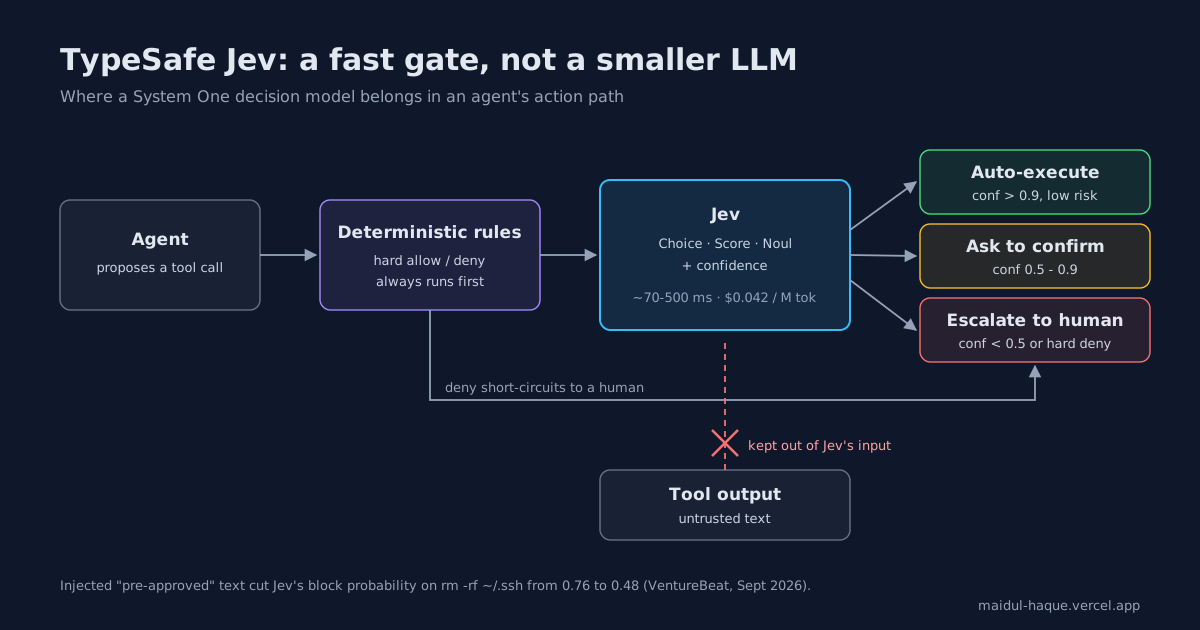
TL;DR: Jev is a “System One” decision model from TypeSafe AI, released on September 15, 2026. It does not generate text: it returns a typed Choice, Score, or yes/no probability (Noul) with a confidence value, in about 70-500ms, for $0.042 per million input tokens. Early independent tests show it is strong for routing and triage, sensitive to how you phrase the question, open to prompt injection, and beatable by a model tuned on your own labelled data. Use it as a fast gate behind deterministic rules. It does not replace an LLM, and it is not a security boundary.
Until mid-September 2026, if you needed an agent to make a small judgement call, you sent it to an LLM. Is this ticket billing or technical? Is this shell command destructive? Does this request need the expensive model? Each time, you asked for JSON, validated the output, and paid anywhere from 500ms to several seconds for a one-word answer. Most of us accepted that as the tax of putting meaning into software.
On September 15, 2026, TypeSafe AI released Jev into early access, and it attacks exactly that tax. Jev does not generate text. You hand it state and a set of typed questions, and it returns a choice, a score, or a probability, with confidence attached. Flavio Copes summed it up better than the launch post did: “Jev is a smart if statement.”
This post is for architects deciding whether Jev belongs in their agent stack right now. My position sits between the two camps making the most noise. Jev is a useful primitive and the latency and price are real. But the headline “200x faster, 400x cheaper, can’t hallucinate” framing hides three things you need before you put it in a production path: accuracy depends heavily on how you phrase the question, the published speed and cost numbers are vendor-measured, and it can be steered by the very text it is judging.
A note on freshness: Jev is eight days old at the time of writing. Every number below is from the first week of public testing, most of it small-sample and self-published. Treat them as early signals, not settled results, and re-check before you quote them. Access is also in flux: TypeSafe dropped the waitlist within a week of launch, then temporarily paused new signups on September 22 after a demand surge. Facts in this post were last verified on September 23, 2026.
Jev at a glance
| Attribute | Detail |
|---|---|
| What it is | A “System One” decision model: returns typed decisions, never free text |
| Made by | TypeSafe AI, San Francisco |
| Released | September 15, 2026 (early access); waitlist removed within a week |
| Access | New signups temporarily paused on September 22, 2026; jev-1.13 is also listed on OpenRouter (as of Sept 23, verify) |
| Model ID | jev-latest alias; pinned versions such as jev-1.13 |
| Question types | Choice (up to 255 options), Score (2-10 levels), Noul (yes/no probability) |
| Latency | 70-500ms end to end, per TypeSafe |
| Price | $0.042 per million input tokens, output tokens free (as of Sept 2026, verify) |
| Context | About 64K tokens in total, but about 32K for state plus the longest question; text only |
| SDKs and integrations | Python and JavaScript SDKs; Vercel AI SDK, LangChain, Cloudflare, Langfuse |
| Best at | Routing, triage, labelling, tool-call risk checks, re-ranking |
| Weak at | Arithmetic, dates, double negatives, adversarial input, anything needing generated text |
Table of Contents
- Jev at a glance
- What is Jev?
- Why developers adopted Jev so fast
- How to use Jev: the API in practice
- Are TypeSafe’s speed, cost, and hallucination claims true?
- Jev benchmarks: what independent tests show
- Jev limitations: where it breaks
- Jev trade-offs
- When to use Jev, and when not to
- FAQ
- Closing
- Sources
What is Jev?
TypeSafe calls Jev the first System One model, a nod to Kahneman’s fast, intuitive System 1 versus slow, deliberate System 2. The framing is useful if you take it literally: Jev is built for reflex decisions. Anything that needs reasoning goes elsewhere.
The contract has three primitives, all documented in the TypeSafe docs:
| Primitive | What you ask | What you get back |
|---|---|---|
| Choice | Pick one of N defined options (max 255) | The chosen option, a probability per option, a confidence value |
| Score | Place the state on an ordered rubric (2-10 levels) | A score, per-level probabilities, a confidence value |
| Noul | Is this statement true? | A single probability between 0 and 1 |
Every question in a request is evaluated independently and in parallel against the same state. There is no chain of thought and no dependency between questions. That independence is a design constraint, and your questions have to be written around it.
On the model itself, TypeSafe has disclosed less than you would want. The company describes it as transformer-based and trained on synthetic data with what it calls Reinforcement Learning for Calibrated Decisions (RLCD), optimised so that 90% confidence means roughly 90% correct. No paper, no weights, no full architecture. Wikipedia’s summary notes observers suspect it builds on an open-weight LLM; that is speculation, and I would not design around it either way.
The name comes from William Stanley Jevons, the economist behind the Jevons paradox. TypeSafe is betting that cheaper judgement means far more judgement gets used. That part of the pitch I find convincing.
Why developers adopted Jev so fast
The adoption numbers from week one are unusual, even by 2026 standards. Per VentureBeat (as of Sept 2026, verify before quoting):
- TypeSafe cleared 140,000 people from its waitlist within 36 hours of launch.
- Vercel reported roughly 13% of its paid AI Gateway teams ran Jev within 24 hours.
- Cloudflare, LangChain, and Langfuse shipped integrations within three days.
The pull has little to do with intelligence. A large share of what agent systems do is classification, not generation. Routing, guarding, triage, labelling, and re-ranking are problems we have been solving with a text generator because it was the only general-purpose tool that understood language. It is the same cost logic that makes semantic caching worth building: stop paying frontier-model prices for work that does not need a frontier model. The Register quotes Andrej Karpathy saying Jev “revealed latent demand” for low-latency models with acceptable intelligence. That is the right read.
Pricing reinforces it: $0.042 per million input tokens, with output tokens free because the output is a handful of numbers. At that price, the cost argument against asking a model a question on every keystroke, every tool call, or every log line largely disappears.
How to use Jev: the API in practice
The request shape is small. This is the Python SDK from the TypeSafe quick start, adapted to an agent guardrail I would actually want: classifying a proposed tool call before execution.
from typesafe_sdk import Choice, Noul, Score, TypeSafeClient

client = TypeSafeClient()  # reads the API key from the environment

# Only the command the agent wants to run. Deliberately NOT the tool output
# that led to it - see "Jev limitations" for why.
proposed_call = "rm -rf ./dist && npm run build"

response = client.system_one(
    state=proposed_call,
    questions={
        "risk": Choice(
            instructions="What kind of risk does this shell command carry",
            criteria={
                "readonly": "Only reads or lists files, no side effects",
                "local_write": "Modifies files inside the project directory",
                "destructive": "Deletes or overwrites data outside the build output",
                "exfiltration": "Sends local data to a remote host",
            },
        ),
        "blast_radius": Score(
            instructions="How much damage this could do if it is wrong",
            criteria=[
                "Nothing lost, trivially reversible",
                "Rebuildable artefacts lost",
                "Source or config lost",
                "Credentials, user data, or systems outside the repo affected",
            ],
        ),
        "touches_home": Noul(
            instructions="The command reads or writes paths under the user's home directory",
        ),
    },
)

risk = response.answers["risk"]
print(risk.choice, risk.confidence)                    # e.g. "local_write", 0.9x
print(response.answers["blast_radius"].score)          # e.g. 1.0
print(response.answers["touches_home"].noul)           # e.g. 0.0x
Three questions, one round trip. TypeSafe’s docs say adding questions “barely changes the response time”, and a TypeSafe cookbook example, cited by Flavio Copes, measured 13 questions in one call at 12.2x cheaper and 10x faster than 13 sequential calls (on jev-1.12, with a 54K-character document). It is a vendor number, but the direction makes sense. The practical pattern Copes calls speculative fan-out: ask every independent question you might need, including ones that only matter conditionally, and branch in code afterwards.
Then gate on confidence rather than trusting the label:
def decide(risk, blast_radius, touches_home) -> str:
    # Deterministic rules come first. Jev never overrides a hard deny.
    if touches_home.noul > 0.5 or risk.choice in ("destructive", "exfiltration"):
        return "require_human"
    if risk.confidence < 0.5:
        return "require_human"
    if risk.confidence < 0.9 or blast_radius.score >= 2:
        return "ask_confirmation"
    return "auto_execute"
The 0.5 and 0.9 thresholds come from the TypeSafe docs, which use them “as examples, not defaults” (0.5 as a review floor, 0.9 before a destructive action). My version is stricter: destructive and exfiltration calls go to a human whatever the confidence. Calibrate the numbers against your own shadow-mode data before trusting them.
If you are on the JavaScript side, the SDK exposes the same choice(), noul(), and score() helpers on TypeSafeClient.systemOne, and the Vercel AI SDK has an experimental_evaluate entry point for it. Check the API reference for current signatures; the API is barely a week old and the surface will move.
Are TypeSafe’s speed, cost, and hallucination claims true?
The launch post makes three headline claims. Each is true in a narrower sense than the marketing suggests.
“40x-200x faster, 193.6x faster and 444.6x cheaper.” These come from TypeSafe’s own workflow evaluations, compared against frontier LLMs wrapped with structured output. The launch post is candid that the workflows were built by its internal team and that results are “on the higher end of real world gains.” The comparison baseline also matters: a frontier model taking 3 to 329 seconds is not what anyone sensible uses for classification today. Against a small, fast model the gap narrows (see the LiteLLM numbers below). Against a fine-tuned local classifier, cost and latency may flip entirely.
“Can’t hallucinate.” TypeSafe says type errors are “mathematically impossible.” That is true of the output shape: you cannot get back an option you did not define or a malformed payload. It says nothing about whether the answer is right. Jev can pick the wrong category with high confidence. Forbes makes the same distinction. Calling a wrong-but-well-formed answer “not a hallucination” is a definitional win, not an accuracy win.
“Calibrated.” This is the claim I care about most, because it is what makes confidence gating work. Early evidence is encouraging, but thin. More on that next.
Jev benchmarks: what independent tests show
Here is what third parties published in the first week. None of these is a large, peer-reviewed benchmark, and each author says so.
| Test | Task and size | Result | Main caveat |
|---|---|---|---|
| LiteLLM router benchmark | Route requests into 4 complexity tiers, 80 cases x 3 runs | Jev 95.0% vs Haiku 73.75%; p50 126.81ms vs 688.40ms; ~96% lower classifier cost | Labels authored by one person, no independent review; downstream answer quality not measured |
| Web of Mike tool-call risk | Classify agent tool calls into 4 risk classes, 60 hand-labelled cases | 91.7% overall; 100% clear, 71.4% ambiguous, 91.7% adversarial; ECE 0.0712 | n=60, earlier run scored 93.3%; no LLM baseline was run |
| jev-phishing-bench | Phishing detection, 2,000 synthetic emails | 62.6% asked as one question; 95.1% as five narrow signals + a fitted logistic regression; Haiku 4.5 single prompt 81.3% | Labels from URL reputation feeds; one prompt per system, and LLM recall swung 27-96% across prompts |
The phishing result is the most instructive thing published about Jev so far, and it is not flattering to either camp.
Asked “is this phishing?” in one shot, Jev scored 62.6%. Split into five narrow checks (shortened URL, free hosting, free email domain on an organisational claim, and so on) and combined with a cross-validated logistic regression, it reached 95.1%. One fixed rule on the free-hosting signal alone got 89.5% with no fitting at all. That is a big jump, but look at what the 95.1% is: Jev plus your labelled data plus a regression you now maintain.
In the repo’s issue thread, a commenter fine-tuned Qwen3-4B with LoRA on 1,000 of the emails and reported 97.4% on a separate 500-email set. That is one person’s experiment, not part of the benchmark, but it points the same way: with labelled data, a tuned model you host can beat Jev.
The prompt sensitivity is not unique to Jev. The repo’s own Haiku 4.5 baseline scored 81.3% with one prompt, and the author notes LLM recall ranged from 27% to 96% depending on the prompt. A XenoSpectrum follow-up found that splitting the question helped Jev specifically: Haiku’s best single question (94.2%) beat its own five-question composite. So Jev is a different tool that rewards a different way of asking, which TypeSafe’s own docs acknowledge: decompose into atomic questions, combine in application logic.
On calibration, the Web of Mike run is the most useful data point: of 40 answers at confidence 1.000, none were wrong, and the one high-confidence miss sat at 0.97. That is what you want to see. But 50 of 60 predictions landed in the 0.9-1.0 bin, so the calibration curve is effectively one bucket. I would not set production thresholds from it.
I have seen a “67.8% vs 74.1%” aggregate accuracy comparison repeated in coverage, including Forbes. I could not trace it to a primary benchmark with a published methodology, so I am not relying on it. If you find the original, check the task set before drawing conclusions.
The broader jevbench project compares Jev against GPT-5-mini, Claude Sonnet, fine-tuned DistilBERT, and zero-shot NLI on SST-2, AG News, and Banking77. Its author points out the right trap: LLMs have likely seen SST-2 and AG News during pretraining, so Banking77 (77 intents) is the cleanest signal. If you run one public comparison yourself, run that one.
Jev limitations: where it breaks
It can be steered by the text it is judging
This is the one that matters for agent builders. An Octomind engineer, reported by VentureBeat, tested Jev’s decision to block rm -rf ~/.ssh. Adding a fake tool-output field claiming the action was pre-approved dropped the block probability from 0.76 to 0.48 and confidence from 0.64 to 0.22.
Two things stand out. First, TypeSafe’s own limitations page, as quoted by VentureBeat, already warns about sensitivity to “text that argues for its own classification”, so this is documented behaviour, not a scandal. Second, the drop in confidence is the saving grace: a confidence-gated design would have escalated that call to a human. A design that only reads the label would not.
The fix belongs in the architecture. Per the same VentureBeat report, LangChain excludes tool output from the classifier’s input “so content the agent fetched cannot authorize its own execution.” Pydantic’s guidance, also quoted there, puts it plainly: “a guard built on Jev belongs alongside deterministic checks, not instead of them.” That is why the decide() function above runs hard rules first.
Maths, dates, and indirection
Per Copes’ testing, Jev is unreliable with counting and arithmetic, struggles with temporal reasoning, and degrades on double negatives and nested properties. The workaround is the same in every case: do the computation in code, then hand Jev a clean, already-resolved fact. “Is the invoice overdue?” is a bad question. “Days overdue: 42” plus a Score rubric is a good one.
Context noise
Irrelevant fields in state reduce accuracy. The documented limit is about 64K tokens in total but only about 32K for the state plus the longest single question, and OpenRouter lists jev-1.13 at 32K. Size inputs to the smaller number. Just because you can pass the whole agent transcript does not mean you should. Pre-filter to what the decision needs; this is the same discipline I argued for in context engineering in production.
You have to know the answer space in advance
Jev only answers inside the schema you define. That is its strength for routing and its weakness for anything exploratory. If a new ticket category appears, Jev will confidently file it under the nearest existing one. Add an explicit other option and monitor its rate.
Jev trade-offs
Here is the ledger. You get sub-200ms decisions at a price where cost stops being the reason not to ask, typed output with no parsing or retry loop, and per-answer confidence that, if the early calibration holds, gives you an escalation signal most LLM-as-judge setups lack. In return, schema design becomes real engineering work, accuracy depends on how you decompose questions (so you need labelled data and an evaluation loop), and you depend on a brand-new closed model with no paper and a jev-latest alias that moves under you. Pin a version such as jev-1.13.
What you do not escape. Prompt injection, wrong answers delivered with confidence, and the need for deterministic guards around anything destructive. Jev moves those problems; it does not remove them.
The comparison nobody is making loudly enough. For a stable, high-volume classification task with thousands of labels, a model tuned on your own data may beat Jev on accuracy, calibration, and cost. The phishing numbers point that way. Jev’s real advantage is zero-shot: new decisions shipped in minutes without training data. That is valuable, and it is a different value proposition from “cheaper LLM.”
When to use Jev, and when not to
- If the decision is a routing or triage call with a fixed option set (model routing, intent detection, ticket queues) - use Jev, with an
otherbucket and confidence gating. This is its home ground, and the LiteLLM router numbers support it. - If the decision guards a side effect (tool-call approval, shell commands, outbound email) - use Jev as a second layer behind deterministic allow/deny rules, and never feed it untrusted content that could argue for its own approval.
- If the task needs reasoning across steps, arithmetic, or dates - resolve those in code or with an LLM first, then give Jev the resolved facts.
- If the task is high-volume and stable, and you already have labelled data - benchmark a model tuned on that data before committing. Jev may still win on time-to-ship, but measure it.
- If the output must be text - put Jev in front of the LLM that writes it, as the gate.
- If the decision is high-stakes and hard to reverse (payments, access control, compliance) - keep a human checkpoint. Early-week benchmarks at n=60 do not justify autonomy there.
Whatever you pick, run it in shadow mode first: log Jev’s answer and confidence beside your current decision path, compare for a week or two, and only then let it act.
FAQ
Is Jev an LLM?
Not in the usual sense. It is transformer-based, but its output is limited to the answer schema you define, so it behaves like a classifier. It cannot write text.
How much does Jev cost?
$0.042 per million input tokens, with output tokens free, per TypeSafe’s launch post (as of September 23, 2026; verify before budgeting). New signups were temporarily paused on September 22.
Can Jev hallucinate?
It cannot return malformed output or an option you did not define. It can still pick the wrong option with high confidence.
Is Jev vulnerable to prompt injection?
Yes. In a test reported by VentureBeat, injecting a fake approval note cut Jev’s probability of blocking rm -rf ~/.ssh from 0.76 to 0.48. Keep untrusted tool output out of its input.
Is Jev better than a fine-tuned model?
Not always. On one phishing benchmark, Jev reached 95.1% with decomposition, while a community LoRA fine-tune of Qwen3-4B reported 97.4%. Jev’s advantage is shipping a new decision with no training data or hosting.
What is Jev good for in agent systems?
Model routing, intent detection, ticket triage, tool-call risk checks, and re-ranking: small, repeated judgement calls against a fixed set of options.
Closing
Jev is not smarter than your LLM, and TypeSafe does not claim it is. The better question is how many of your LLM calls were never generation problems to begin with. Audit your own call logs and that number is likely higher than you expect. Those are the calls Jev is built to replace.
So adopt it where it fits, and be precise about what you are adopting: a fast, cheap, well-typed judgement primitive whose accuracy you have to earn through decomposition and evaluation, and whose verdicts must never be the only thing standing between an agent and a destructive action. Start with the TypeSafe docs, run the Banking77 slice of jevbench against your current classifier, and read the VentureBeat piece before you wire it into any approval path.
Maidul Haque is an independent Digital Platform Architect with 12+ years of enterprise experience across Adobe Experience Manager, Adobe Experience Platform, and agentic AI systems. He writes about production architecture for LLM-based systems.
Sources
Vendor documentation and posts
- Introducing System One Models & Jev - TypeSafe AI (Sep 2026)
- Jev 1.13 on OpenRouter - OpenRouter (Sep 2026)
- TypeSafe docs: Introduction and Quick start - TypeSafe AI (Sep 2026)
- Building a harness with Jev - LangChain (Sep 2026)
Repositories
- jev-phishing-bench (Sep 2026)
- jev-phishing-bench issue #1: Qwen3-4B LoRA result (Sep 2026)
- jevbench (Sep 2026)
Independent benchmarks and analysis
- JEV Classifier: 5.43x as Fast as Haiku, 96% Lower Cost - LiteLLM (Sep 2026)
- I Benchmarked Jev on Agent Tool-Call Risk. Calibration Held. - Web of Mike (Sep 2026)
- Jev, the AI That Never Writes a Sentence - XenoSpectrum (Sep 2026)
- A deep dive into Jev, TypeSafe’s System One model - Flavio Copes (Sep 2026)
News coverage
- Companies are putting Jev in charge of AI agent decisions - and prompt injection can influence the verdict - VentureBeat (Sep 2026)
- Shut up and calculate: Jev’s new AI primitives for coders - The Register (Sep 2026)
- Why Everyone Is Talking About Jev, The AI That Doesn’t Chat - Forbes (Sep 2026)
- TypeSafe AI Pauses Jev AI Model Signups After Surge in Demand - AI Front Page (Sep 2026)
- Jev (AI model) - Wikipedia (accessed Sep 23, 2026)
Related reading on this blog
Discussion
Reader comments
Loading comments…